

As a reliable mini spider crane supplier, I'm often asked about the technical details of our products. One of the most frequently inquired - about aspects is the counterweight system of the mini spider crane. In this blog, I'll delve into how this crucial system functions.
The Basics of a Mini Spider Crane's Counterweight System
First, let's understand what a mini spider crane is. Mini spider cranes are compact lifting machines that can access tight and hard - to - reach spaces. They are equipped with a series of outriggers, giving them a stable base similar to a spider's legs, hence the name.
The counterweight system in a mini spider crane plays a vital role in maintaining stability during lifting operations. When a crane lifts a load, it creates a moment or turning force around its base. If the crane were to rely solely on its own structure, this moment could cause it to tip over. The counterweight is added to the opposite side of the load to counteract this turning force.
Components of the Counterweight System
The counterweight system consists of several key components. The counterweight itself is usually made of dense materials such as cast iron or steel. These materials are used because they can provide a high mass in a relatively small volume.
There is also a mounting mechanism that attaches the counterweight to the crane. This mechanism must be strong and secure to ensure that the counterweight stays in place during operation. In some cases, the counterweight can be adjusted or removed, allowing the crane to be configured for different lifting tasks.
How the Counterweight Works
When a mini spider crane is about to lift a load, the operator needs to calculate the appropriate amount of counterweight required. This calculation takes into account the weight of the load, the distance of the load from the crane's center of rotation, and the crane's own weight and dimensions.
Let's say we have a 3t Mini Spider Crane that is going to lift a 1 - ton load at a distance of 5 meters from the center of rotation. Using the principle of moments (the moment of a force is equal to the force multiplied by the perpendicular distance from the pivot point), the load creates a clockwise moment. To balance this, the counterweight on the other side of the crane must create an equal and opposite counter - clockwise moment.
The formula for the moment is (M = F\times d), where (M) is the moment, (F) is the force (in this case, the weight of the load or counterweight), and (d) is the distance from the pivot. So, if the counterweight is placed at a distance of 2 meters from the center of rotation, we can calculate the required weight of the counterweight ((F_{c})) using the equation (F_{l}\times d_{l}=F_{c}\times d_{c}), where (F_{l}) is the weight of the load, (d_{l}) is the distance of the load from the pivot, and (d_{c}) is the distance of the counterweight from the pivot.
Substituting the values: (1000\ kg\times5\ m = F_{c}\times2\ m), we get (F_{c}=2500\ kg). So, a counterweight of 2500 kg would be required to balance the load at this particular configuration.
Adjustability of the Counterweight System
One of the advantages of the counterweight system in a mini spider crane is its adjustability. Different lifting tasks require different amounts of counterweight. For light - duty tasks, less counterweight may be needed, which allows for a more mobile and flexible operation.
For heavier loads or when the load is placed at a greater distance from the crane's center, more counterweight can be added. This adjustability is achieved through various means. Some cranes have modular counterweights that can be added or removed easily. Others may have a mechanism that allows the counterweight to be moved further away from the center of rotation, increasing its moment - creating ability without adding more mass.
Safety Considerations
The counterweight system is also a critical safety feature. If the counterweight is not properly configured, the crane can become unstable, leading to accidents. That's why it's important for operators to be trained in calculating and adjusting the counterweight correctly.
In addition to proper calculation, the counterweight system must be inspected regularly. The mounting mechanism should be checked for signs of wear or damage, and the counterweight itself should be inspected for any cracks or deformations.
Applications and the Role of the Counterweight System
Mini spider cranes are used in a variety of industries, including construction, maintenance, and event setup. In construction, they can be used to lift building materials in tight spaces such as inside buildings or between narrow alleys. The counterweight system ensures that these lifts can be done safely, even when working in cramped conditions.
For maintenance work, such as replacing HVAC units on rooftops or servicing high - rise windows, the counterweight system allows the crane to balance the load and maintain stability on elevated surfaces.
In event setup, mini spider cranes can be used to install lighting rigs, sound systems, and stage decorations. The counterweight ensures that the crane can handle these tasks without toppling over, even in dynamic environments.
Comparing with Other Crane Types
It's interesting to compare the counterweight system of a mini spider crane with that of other types of cranes. For example, 10t Crawler Crane and 5t Mini Crawler Crane. Crawler cranes generally have a much larger base and are designed to carry heavier loads. Their counterweight systems are often larger and more permanent, as they are built for large - scale construction projects.
In contrast, the mini spider crane's counterweight system is more compact and adjustable, allowing it to adapt to a wider range of small - scale and space - restricted tasks. The relatively small size of the mini spider crane also means that it can be transported more easily, which is beneficial for jobs that require quick setup and relocation.
Conclusion
The counterweight system of a mini spider crane is a sophisticated and essential part of its design. It enables the crane to lift loads safely and efficiently in various environments. Whether you are working on a small - scale construction project, performing maintenance tasks, or setting up an event, the proper functioning of the counterweight system is crucial.

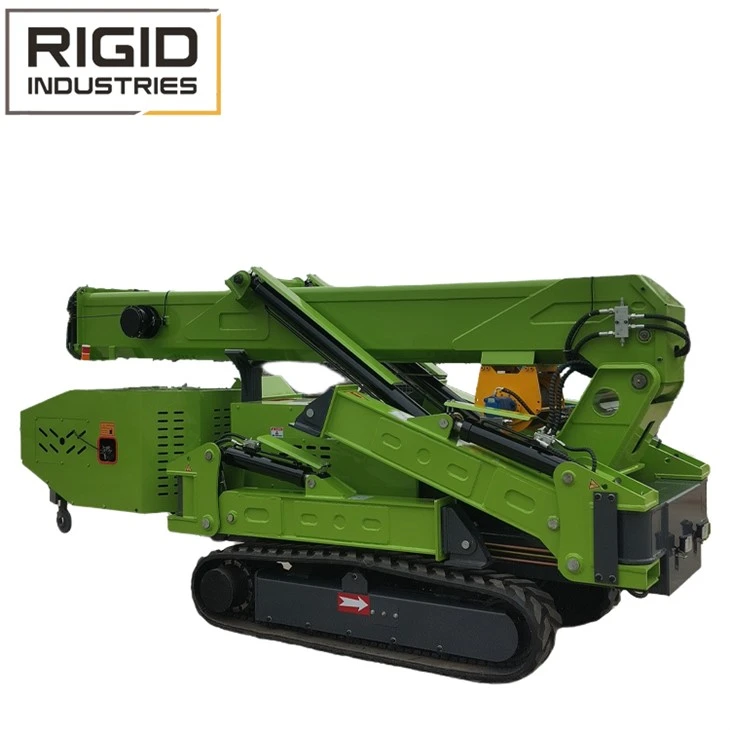
If you are in the market for a mini spider crane or have any questions about our counterweight systems, we're here to help. We can provide you with detailed information on the specifications of our products and assist you in choosing the right crane for your needs. Reach out to us to start a conversation about your project requirements and how our mini spider cranes can be a valuable addition to your operations.
References
- "Crane Engineering Handbook", XYZ Publishers
- "Lifting Equipment Safety Guide", ABC Publications


