


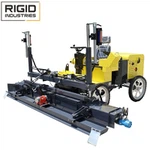
Telescopic Loader
Your Professional Telescopic Loader Supplier
RIGID INDUSTRIES CO., LTD is a trading & manufacture for Chinese construction machines.
Our hot selling products are wheel loaders, excavators, skid loaders, forklifts, backhoe loaders etc.


Why Choose Us
Export Experience
Our company has accumulated extensive international export experience through 15 years of dedicated global distribution of construction machinery.
Complete Product Qualifications
The majority of our products are certified with CE and other relevant international standards, ensuring compliance and quality.
OEM Services
We also offer OEM (Original Equipment Manufacturer) services for leading machinery brands, including BOBCAT, XCMG, and SINOMACH, supporting customized production and branding solutions.
Parameter
|
Max. Reach (Boom Extended) |
3,000mm |
|
Max. Reach (Boom Retracted) |
2,480mm |
|
Min. Turning Radius |
2,480mm |
|
Turning Angle |
45º |
|
Rated Loading Capacity |
850kg-1,000kg |
|
Max. Lifting Height to the Pin |
3,000mm |
|
Driving Speed |
12km/H |
|
Transmission |
4WD |
|
Weight |
1,860kg |
|
Standard Tire |
26X12-12 |
|
Tire Pressure |
2.8Bar |
|
Oil Tank Capacity |
40L |
|
Pressure |
190bar |
|
Working Oil Flow |
67L/min (2 Pumps) |
|
Tracking Oil Flow |
78L/min |
|
Oil Model(mineral oil) |
L-HL46 |
|
Fuel Tank Capacity |
23L |
|
Battery Capacity |
60Ah |
|
Voltage |
12v |

Benefits of Telescopic Loader
Reach and Lift
The extendable boom enables these machines to lift loads to significant heights, ideal for stacking materials on multi-story structures or reaching over obstacles.
Attachment Options
Telescopic loaders can be outfitted with a variety of attachments, such as buckets, winches, and work platforms. This adaptability allows them to perform multiple tasks, reducing the need for multiple machines on-site.
Maneuverability
Telehandlers are designed to navigate through tight spaces and rough terrain, making them suitable for both indoor and outdoor applications.
Cost Efficiency
By consolidating multiple functionalities into a single piece of equipment, construction companies can save on both equipment rental/purchase costs and space.
Safety
Modern telescopic loaders come equipped with advanced safety features such as load moment indicators and stabilizers, minimizing the risks associated with heavy lifting.
Safety Precautions for Telescopic Loader
Ensure operators are properly trained
Telescopic loader training courses give workers the knowledge required to conduct telescopic loader operations in industries such as construction, resources and infrastructure. Anyone using a telescopic loader at work should be able to demonstrate their competency before using the machine.
Pre-inspection and workplace hazard assessment
Before you begin, always perform an inspection of the machine, the environment, and check critical functions on the telescopic loaders are in good working order. If an issue or a malfunction is suspected, notify your supervisor and remove the telescopic loader from service until it can be fixed.
Keep loads safe
In your training, you’ll learn how important loading and unloading a telescopic loader is, and how to assess what your machine is capable of. Excessive or unbalanced loads could cause the telescopic loader to tip over so always ensure load capacity charts are available and the load doesn’t exceed the machine’s capabilities.
Travel safely on slopes
Driving or travelling along a slope creates a risk factor of overturning the telescopic loader. This risk increases if a freely suspended or unsecured load is carried because the load can shift unexpectedly and reduce the stability of the machine. Always travel directly up or down a slope and avoid travelling across a side slope, or reversing down a slope. Lower the boom before travelling, move slowly, and always secure loads that could shift.
Keep workers at height safe
When working at height, always use a work platform that is directly mounted and fixed to the telescopic loader (not on forks) and is approved for use by the manufacturer. Never use a makeshift work platform or one that slips onto the forks. The operator must be trained and competent to operate a boom-type EWP, for example with the EWPA Yellow Card.
Beware of crush hazards
Operators need to be aware of the surroundings and the movement of people and vehicles on the job site. Keep other workers away from the area when loads are lifted and in transit and never leave the cabin if the booms are raised.
Look out for electrical hazards
Your initial hazard assessment should identify any overhead power lines, trees or other structures that are liable to be a hazard. It’s good practice to always treat all overhead power lines as being live, unless the power company that owns the power lines formally advises that the lines are safe.
Additional Information
|
Payment term |
30% deposit, 70%TT balance payment before the shipping |
|
Transportation |
Ocean freight. |
FAQ