

As a supplier of 12t crawler cranes, I am often asked about the control systems that make these powerful machines operate efficiently and safely. In this blog post, I will delve into the various control systems of a 12t crawler crane, explaining their functions and importance in the overall operation of the crane.
1. Main Control System
The main control system of a 12t crawler crane serves as the brain of the machine. It is responsible for coordinating and regulating all the major functions of the crane, including hoisting, luffing, slewing, and traveling. This system typically consists of a control panel located in the operator's cab, which is equipped with a variety of switches, levers, and buttons.

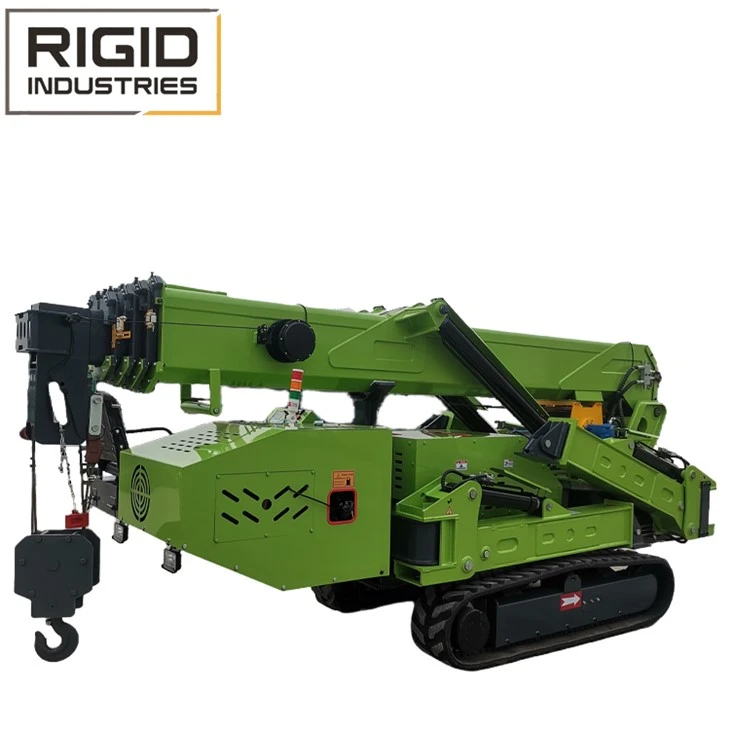
The control panel allows the operator to input commands and monitor the status of the crane. For example, the hoisting control lever is used to raise and lower the load, while the luffing control lever adjusts the angle of the boom. The slewing control lever enables the operator to rotate the upper structure of the crane, and the traveling controls are used to move the crane forward, backward, left, or right.
Modern 12t crawler cranes are often equipped with advanced electronic control systems that use microprocessors and sensors to enhance the precision and safety of the operation. These systems can automatically adjust the speed and force of the crane's movements based on the load being lifted, the position of the boom, and other factors. They also provide real - time feedback to the operator, such as load weight, boom angle, and working radius, through a display on the control panel.
2. Hoisting Control System
The hoisting control system is one of the most critical components of a 12t crawler crane. Its primary function is to lift and lower heavy loads safely and efficiently. This system consists of a hoist drum, a motor, a gearbox, and a braking system.
The hoist drum is driven by an electric or hydraulic motor, which is controlled by the operator through the hoisting control lever on the main control panel. When the operator moves the lever forward, the motor rotates the hoist drum in one direction, causing the wire rope to wind around the drum and lift the load. Conversely, when the lever is moved backward, the motor rotates the drum in the opposite direction, and the load is lowered.
The gearbox is used to reduce the speed of the motor and increase the torque, allowing the crane to lift heavy loads. The braking system is essential for ensuring the safety of the hoisting operation. It can quickly stop the rotation of the hoist drum in case of an emergency or when the load needs to be held in place. Modern hoisting control systems often use multiple braking mechanisms, such as electromagnetic brakes and hydraulic brakes, to provide reliable and fail - safe operation.
3. Luffing Control System
The luffing control system is responsible for adjusting the angle of the crane's boom. This is important for reaching different heights and distances when lifting loads. The luffing mechanism typically consists of a hydraulic cylinder or a winch system.
In a hydraulic luffing system, the hydraulic cylinder is extended or retracted by the operator using the luffing control lever on the main control panel. As the cylinder moves, it changes the angle of the boom, allowing the crane to reach higher or lower positions. The hydraulic system provides smooth and precise control of the boom angle, and it can also hold the boom in place under heavy loads.
Some 12t crawler cranes use a winch - based luffing system. In this system, a wire rope is wound around a winch drum, and the tension in the wire rope is adjusted to change the boom angle. The winch is driven by an electric or hydraulic motor, and the operator controls the speed and direction of the winch through the control panel.
4. Slewing Control System
The slewing control system enables the upper structure of the 12t crawler crane to rotate horizontally. This allows the crane to position the load accurately in different directions. The slewing mechanism consists of a slewing ring, a slewing motor, and a reduction gear.
The slewing ring is a large bearing that connects the upper structure of the crane to the lower chassis. The slewing motor, which can be electric or hydraulic, drives the slewing ring through the reduction gear. The operator uses the slewing control lever on the main control panel to control the rotation of the upper structure. The slewing control system provides smooth and precise rotation, and it can be adjusted to different speeds depending on the requirements of the operation.
5. Traveling Control System
The traveling control system is used to move the 12t crawler crane from one location to another. The crawler crane is equipped with a pair of crawler tracks, which are driven by hydraulic motors.
The traveling control system allows the operator to control the speed and direction of the crane's movement. The operator can use the traveling controls on the main control panel to move the crane forward, backward, turn left, or turn right. The hydraulic motors provide sufficient power to move the heavy crane over various terrains, including rough and uneven surfaces.
6. Safety Control Systems
In addition to the main control systems, 12t crawler cranes are equipped with a variety of safety control systems to prevent accidents and ensure the safety of the operator and the surrounding environment.
- Load Moment Indicator (LMI): The LMI is a crucial safety device that monitors the load being lifted and the working radius of the crane. It calculates the load moment (the product of the load weight and the working radius) and compares it with the crane's rated load capacity. If the load moment exceeds the safe limit, the LMI will issue an alarm and may even prevent the crane from performing certain operations.
- Overload Protection System: This system is designed to prevent the crane from lifting loads that exceed its rated capacity. It can automatically stop the hoisting operation or reduce the lifting speed when an overload is detected.
- Anti - two - block System: The anti - two - block system is used to prevent the hook block from colliding with the boom tip. It uses sensors to detect the position of the hook block and the boom tip, and it will stop the hoisting operation if a potential collision is detected.
7. Our Product Advantages
As a supplier of 12t crawler cranes, we take pride in offering high - quality products with advanced control systems. Our cranes are designed and manufactured to meet the highest safety and performance standards.
We also offer a range of related products, such as the 5t Mini Crawler Crane, 8t Crawler Crane, and 10t Crawler Crane. These products are suitable for different applications and customer needs.
Conclusion
The control systems of a 12t crawler crane play a vital role in its operation, safety, and efficiency. From the main control system that coordinates all functions to the various safety control systems that protect the operator and the equipment, each component is carefully designed and engineered to ensure optimal performance.
If you are in the market for a 12t crawler crane or any of our related products, we invite you to contact us for more information and to discuss your specific requirements. Our team of experts is ready to assist you in making the right choice for your project.
References
- "Crawler Crane Handbook" by Industry Experts.
- Manufacturer's Technical Manuals for 12t Crawler Cranes.


